
Five of Wands Tarot Card Meaning
The Five of Wands shows a group of youths brandishing staves at one another, in what reads as sport as much as strife. What sets it apart from other Wands cards is the absence of a single protagonist and of any clear outcome; the emphasis falls on several forces pushing at once. It can point to healthy sparring, competition and exchange of views, or to a scattered, noisy situation in which everyone speaks and no one is heard. The card describes a condition rather than a verdict: energy is abundant, but its direction is divided and still open to being channelled or allowed to settle.
UPRIGHT
Multiple parties press their claims at once; the friction is real but not yet decisive.
REVERSED
Conflict may turn into disputes, evasion or hidden rivalry, or be suppressed without resolution.
Imagery & symbolism
The imagery described here follows the Rider–Waite–Smith deck.
- Youths raising staves
- Several figures swing long staves in crossing motions without a leader, suggesting many voices asserting themselves at the same time rather than combining.
- Playful, sport-like posture
- The gestures carry a light, game-like quality, implying the clash need not be hostile; it may be practice, probing or competitive interaction.
- Bare, open background
- There is almost no building or fixed setting, so the scene feels temporary and unformed, suggesting the dispute is not yet settled and could still turn toward negotiation.
UPRIGHT
Upright, the Five of Wands often marks a phase of many participants and competing claims. It can appear in group discussions, family disagreements or rivalry among peers, where voices are numerous and positions mixed but no side dominates. Such friction has value: clashing proposals expose overlooked problems and clarify what each person actually wants. Its limits are equally plain. Energy scatters, progress slows, and without someone willing to lower their staff the exchange can stall in mutual proving. The card points to a process of contest and adjustment, not to a decided result.
REVERSED
Reversed, the Five of Wands can move in two directions. On one hand, friction may go underground, becoming evasion, backstage rivalry or repetitive argument, outwardly calm while draining those involved. On the other, conflict may be pressed down or abandoned, easing tension without addressing the underlying disagreement. It can also indicate weariness with pointless quarrelling and a willingness to concede or seek coordination. Which reading fits depends on surrounding cards and circumstances: a tense spread tends toward mounting internal strain, a calmer one toward avoidance or the beginning of reconciliation.
Meanings by question
Love & relationships
UPRIGHT
Small frictions and differences of opinion arise, with both sides eager to be heard, though the issues are not necessarily fundamental.
REVERSED
Arguments may repeat without resolution, or one person may swallow dissatisfaction, leaving surface calm over accumulating distance.
Career & work
UPRIGHT
A team holds varied views and debates energetically; useful for testing options, provided someone is tasked with drawing conclusions.
REVERSED
Responsibility may be passed around, departments may jostle, or meetings may become formalities while problems are shelved rather than solved.
Money & practical matters
UPRIGHT
Money decisions may involve several opinions, as with shared household costs or partnership allocations that need repeated discussion.
REVERSED
Disagreements over accounts, unclear verbal agreements or postponed conversations can let financial friction drift unresolved.
Common misconceptions
Does the Five of Wands mean certain failure or serious conflict?
Not necessarily. The figures' sport-like postures suggest limited intensity, closer to competition, sparring or exchange of views. The card describes a process, not an outcome; results depend on whether participants lower their staves and focus on shared aims.
Does the reversed card mean conflict has vanished and all is calm?
Not always. Reversal can indicate quarrelling pushed underground, suppressed or endlessly deferred, or a person stepping back from pointless drain. Surface calm differs from genuine resolution, so the wider spread should be read to see whether the disagreement was actually addressed.
Related cards & differences
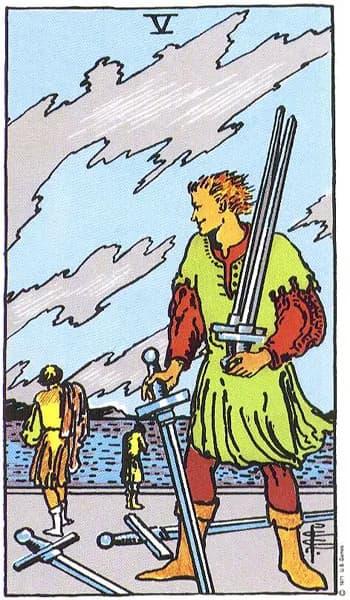
Five of Swords
The Five of Swords also shows multi-party confrontation but stresses a decided outcome and its costs; the Five of Wands stays with unresolved friction and sparring.
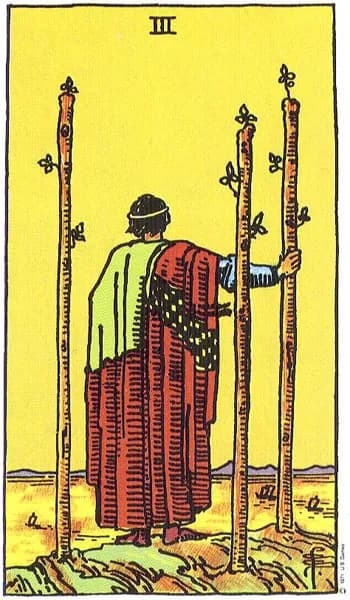
Three of Wands
The Three of Wands shows one figure gazing outward with a clear direction; the Five of Wands shows many figures exerting force in divided directions.
Read the card in your own context
A card’s general meaning is a starting point. Your question and its position in the spread help explain what it contributes to your reading.