Ten of Swords Tarot Card Meaning
The Ten of Swords holds the tension between termination and what remains afterward. In the illustration a figure lies face down, pinned by ten swords, all of which belong to this card, suggesting that the harm came from a complete and cumulative process rather than a single blow. Unlike the Three of Swords with its three blades through the heart, ten is the numerical end of the suit, marking a conclusion that cannot intensify further. It depicts pain, affliction, tears and desolation, yet also implies that once every sword has fallen there is nothing left to lose, and a new possibility appears at the edge of the sky. What distinguishes this card is that it places the heaviest ending and the faintest hope within the same image.
UPRIGHT
Pain and defeat reach their limit as a phase ends completely, yet light appears on the horizon.
REVERSED
May show the worst passing, or refusal to let go, ongoing inner drain, or slow recovery.
Imagery & symbolism
The imagery described here follows the Rider–Waite–Smith deck.
- Prostrate figure
- The figure lies face down, with an exaggerated posture suggesting exhaustion and loss of support. This is a symbolic image of an ending, not a literal forecast of injury or evidence that a real situation has become entirely unchangeable.
- Ten swords
- Ten swords pierce the figure’s back, presenting strain and distress at an extreme. They can evoke a way of coping that has reached its limit, without establishing that someone has betrayed you. Understanding an actual problem still requires facts.
- Distant horizon and light
- A bright band of sky appears beyond the far hills. It suggests the night has reached its end and a new beginning remains possible, though dawn is still distant and requires time.
UPRIGHT
Upright, the Ten of Swords often corresponds to a feeling of having hit bottom: a plan, relationship or phase is ended completely, and the pain arrives fully and concentrated. It may appear as betrayal by someone trusted, long effort coming to nothing, or having to accept an outcome that cannot be repaired. The card does not promise immediate improvement; it asks first that the loss be acknowledged as real rather than quickly dismissed. Its limit is that at this point no action is likely to reverse the situation at once, and forcing resistance only adds exhaustion. Its opportunity lies precisely here: when every sword has fallen there is little room for further deterioration, and a person can stop defending and begin to face things honestly. That honesty is often the starting point of rebuilding.
REVERSED
Reversed, the Ten of Swords has several possible readings depending on context. One is that the worst stage is passing, pain is easing, and a person is gradually recovering the ability to act. Another points to refusal to let go: the situation has ended, yet the mind keeps replaying it and asking why, preventing the wound from closing. It can also indicate pain turned inward, appearing calm on the surface while continuing to drain energy within. In some cases it suggests harm that has been suppressed or not fully acknowledged, so that unprocessed feeling remains beneath an appearance of recovery. In every case the reversal asks for discernment: is this genuine healing, or pain hidden more deeply?
Meanings by question
Love & relationships
UPRIGHT
In relationships it may correspond to a definitive ending or deep disappointment, such as broken trust or a bond beyond repair. It asks for acknowledgment of the hurt rather than an immediate search for replacement.
REVERSED
Reversed, it may show a relationship slowly mending, or one person still trapped in old wounds. It can also point to repeated contact after a breakup that prevents real closure.
Career & work
UPRIGHT
At work it may correspond to a failed project, a layoff, or long effort being dismissed, bringing strong frustration. This is a time to accept reality first, then assess the next step.
REVERSED
Reversed, it may indicate a professional low point passing and direction being regained, or continued complaint about an old environment without taking action.
Money & practical matters
UPRIGHT
Financially it may correspond to a clear loss or a plan falling through, requiring one to face the numbers rather than avoid them. It suggests stopping the loss before discussing recovery.
REVERSED
Reversed, it may show financial pressure beginning to ease, or debt problems being postponed and avoided. Distinguishing real improvement from temporary concealment matters.
Common misconceptions
Does the Ten of Swords mean death or disaster?
No. The primary source states it is not especially a card of violent death. It depicts feelings of pain, affliction, tears and desolation, and the complete end of a phase, not literal mortality.
Does drawing this card mean things can never improve?
Not so. Light is already visible in the distance, suggesting a new beginning after the ending. It describes a bottom state rather than a permanent sentence, and recovery, though slow, remains possible.
Related cards & differences
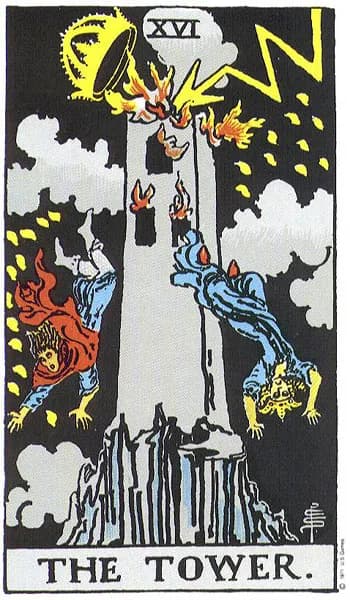
The Tower
The Tower emphasizes sudden collapse and structural ruin, while the Ten of Swords leans toward an ending already accumulated to its peak and the endurance that follows.
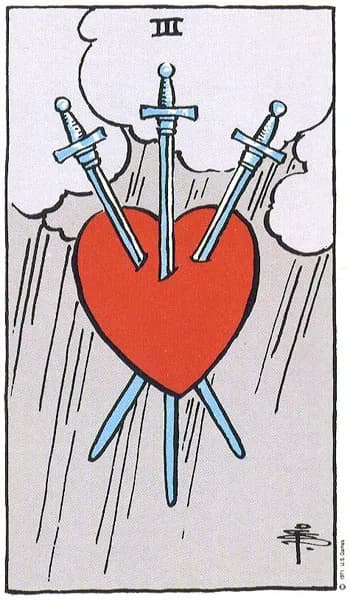
Three of Swords
The Three of Swords is the initial wound of three blades through the heart; the Ten of Swords is the complete conclusion of ten blades falling, differing in degree and stage.
Read the card in your own context
A card’s general meaning is a starting point. Your question and its position in the spread help explain what it contributes to your reading.