
Seven of Swords Tarot Card Meaning
The Seven of Swords centers on the tension between cleverness and integrity. The figure carries away five swords while two remain behind, with a camp nearby, suggesting a strategy that avoids direct confrontation. Unlike the open conflict of the Five of Swords or the quiet transition of the Six, this card is marked by secrecy, strategy, and solitary risk, with outcomes depending on motive and consequence.
UPRIGHT
Using cleverness to take what is needed quietly, avoiding open conflict, though the ethics remain questionable.
REVERSED
Concealment exposed, conscience unsettled, or abandoning trickery for honest counsel.
Imagery & symbolism
The imagery described here follows the Rider–Waite–Smith deck.
- The man carrying swords
- A figure hurries away holding five swords, his posture quick and wary. This suggests obtaining what is needed through stealth, an action that is strategic and avoids direct confrontation.
- Two swords left behind
- Two swords remain stuck in the ground, not taken. This suggests an incomplete plan, a flaw or unresolved part in the trade-off, and hints that the trickery may not stay hidden for long.
- The camp in the distance
- A camp is visible in the background, showing the figure leaving a group. This suggests the action occurs within a relational or collective context, and what is taken originally belonged to others, involving trust and belonging.
UPRIGHT
The upright Seven of Swords often appears when wit is needed rather than force. It may indicate that you are taking an indirect approach, avoiding open conflict, and quietly advancing your goals; it may also indicate that you sense others acting secretly and need to stay alert. The card affirms resourcefulness and adaptability, but warns that if cunning rests on concealment or harm to others, short-term gain may bring long-term unease and relational damage. It does not promise success, but focuses on weighing means against costs.
REVERSED
Reversed, the Seven of Swords has several possibilities. It may indicate that concealment is exposed, that a trick can no longer be sustained, or that someone confesses out of conscience. It may also indicate abandoning opportunism for a legitimate path, or accepting advice and counsel. Another reading is excessive suspicion, interpreting harmless actions as scheming. Reversal does not necessarily point to punishment, but suggests hidden matters surfacing or a strategy needing reassessment.
Meanings by question
Love & relationships
UPRIGHT
There may be concealment, avoidance, or quiet testing in the relationship, with one person handling sensitive topics indirectly rather than communicating openly.
REVERSED
Concealment may be revealed, or both parties may decide to stop suspecting and move toward more direct dialogue, though excessive doubt can also damage trust.
Career & work
UPRIGHT
At work, you may adopt a low-key strategy, push a project alone, or notice covert competition and unequal access to information among colleagues.
REVERSED
Hidden maneuvers may come to light, or you may choose to abandon trickery and rebuild trust transparently, or receive advice from others.
Money & practical matters
UPRIGHT
Financially, you may use indirect means to avoid risk or gain advantage, but consider whether the means are fair and whether hidden problems remain.
REVERSED
Hidden financial issues may surface, or you may decide to stop speculating, seek reliable advice, and re-examine your budget.
Common misconceptions
Does the Seven of Swords always mean deception or betrayal?
Not necessarily. It points more to stealthy action and strategic cunning, and the motive may be self-protection, adaptation, or avoiding conflict. Whether it counts as betrayal depends on whether it harms others and violates trust; it cannot be generalized.
Is the reversed card simply the upright meaning doubled in negativity?
No. Reversal may indicate concealment exposed, a guilty conscience, or abandoning trickery to accept advice, or excessive suspicion. It suggests hidden matters surfacing, not simply punishment.
Related cards & differences
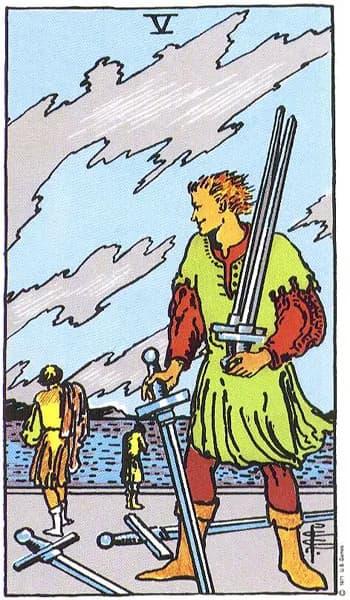
Five of Swords
The Five of Swords depicts open conflict and contests of winning and losing, while the Seven avoids direct confrontation and takes advantage secretly, contrasting their approaches to conflict.
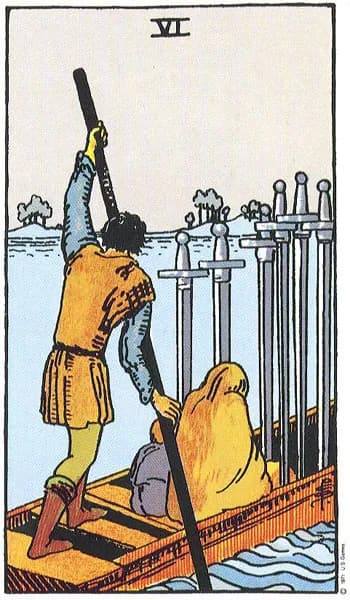
Six of Swords
The Six of Swords is a calm transition carrying sorrow, while the Seven quietly takes what is needed amid unresolved relationships; the former tends toward healing, the latter involves trust and means.
Read the card in your own context
A card’s general meaning is a starting point. Your question and its position in the spread help explain what it contributes to your reading.