Four of Swords Tarot Card Meaning
The core tension of the Four of Swords lies between action and rest. Unlike the Three of Swords, which shows visible pain, or the Five of Swords, which shows open conflict, this card gathers the swords and sinks into silence. The knight lies upon a tomb in prayer, suggesting a chosen retreat and vigil rather than an ending. It asks how one pauses after strain, whether that stillness restores or avoids, and what remains held in reserve.
UPRIGHT
The Four of Swords upright points to a deliberate pause, restoring strength in quiet before returning to action.
REVERSED
Reversed, it can suggest insufficient rest, forced interruption, or prolonged stagnation that needs readjusting.
Imagery & symbolism
The imagery described here follows the Rider–Waite–Smith deck.
- Knight effigy on a tomb
- A knight lies full-length in prayer upon a tomb, suggesting a temporary withdrawal and quiet watchfulness rather than literal death; it evokes setting the body and mind down after turmoil.
- Three swords hung on the wall
- Three swords are mounted evenly on the wall, points downward, contrasting with the reclining knight; this suggests conflict and thought are set aside for now but not gone, still waiting overhead.
- Fourth sword beneath the knight
- A fourth sword lies flat beneath the effigy along the tomb; it suggests an unresolved matter pressed under the resting state, or a latent tension supporting the silence.
UPRIGHT
Upright, the Four of Swords often marks a chosen pause. It may follow a tense event, suggesting stepping back from argument, reducing stimulation, and turning attention toward inner recovery. This rest is not passive; it is a vigil and a gathering of strength, like a deliberate interval after long exertion. Its condition is that the pause remains temporary and the person knows why they have stopped. If the silence becomes permanent retreat, the moment to act may be missed. It can also point to solitude, retreat, convalescence, or distance from noise, though the form varies. The card does not promise that problems resolve themselves; it suggests quiet reorganization and conservation of energy before the next phase.
REVERSED
Reversed, the Four of Swords has several possible readings. It may indicate insufficient rest or forced interruption, where outside pressure prevents真正 stopping and fatigue accumulates. It may also suggest over-stagnation, where a needed break becomes procrastination or avoidance. Alternatively, inner silence may be broken and suppressed thoughts resurface, forcing a return to what was set aside. It can also signal that a rest period is ending and re-engagement is near. Reversal is not automatically negative; it points to a rhythm out of balance, either too little rest or too much. The key is to discern which state applies and adjust accordingly.
Meanings by question
Love & relationships
UPRIGHT
In relationships, the Four of Swords may suggest a cooling-off period, with less argument and space to process feelings. It does not necessarily mean separation, but rather a quiet interval after tension.
REVERSED
Reversed, it may point to a cold war lasting too long, avoidance of communication, or exhaustion that makes response difficult. It can also suggest the silence is ending and dialogue needs reopening.
Career & work
UPRIGHT
At work, it may correspond to a project lull, leave, quiet preparation, or stepping away from a high-pressure environment. This is a time to organize thoughts and recover rather than force progress.
REVERSED
Reversed, work rhythm may be unbalanced: either no rest and ongoing burnout, or a stall lasting too long and missing timing. It may also signal that a break should end and effort resume.
Money & practical matters
UPRIGHT
Financially, the Four of Swords suggests postponing major decisions and observing the current situation. It suits a period of cautious review rather than action.
REVERSED
Reversed, it may indicate missing a window through delay, or acting hastily from anxiety. It can also suggest that stalled financial arrangements need revisiting.
Common misconceptions
Does the Four of Swords mean death or final ending?
No. The tomb and reclining figure can evoke death, but the card's core is pause and recovery, not an ending. It is more like a silent interval after which action may resume.
Does the Four of Swords mean problems are solved?
Not necessarily. Three swords remain on the wall, suggesting conflict is only set aside. Rest helps restore, but what was shelved may still need facing later.
Related cards & differences
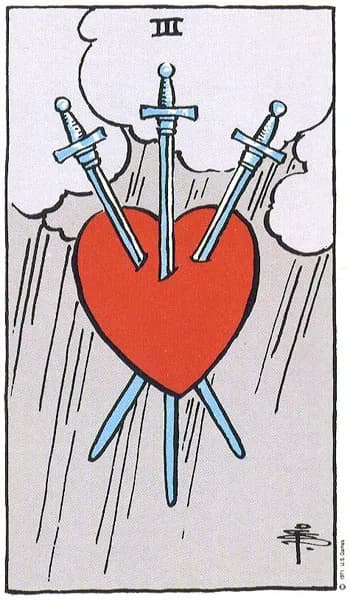
Three of Swords
The Three of Swords centers on visible pain and heartbreak, while the Four of Swords turns toward silent recovery; both follow hurt, but one is outward, the other inward.
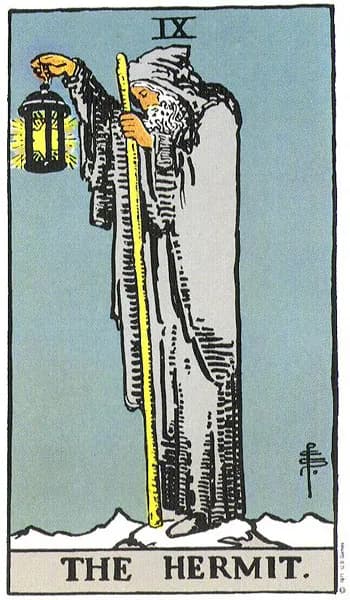
The Hermit
The Hermit also emphasizes solitude and introspection, but the Hermit seeks wisdom and guidance, while the Four of Swords focuses on pausing and recovering after depletion.
Read the card in your own context
A card’s general meaning is a starting point. Your question and its position in the spread help explain what it contributes to your reading.