King of Swords Tarot Card Meaning
The King of Swords sits upright on a stone throne, holding his sword vertically. He represents authority exercised through intellect, principle and clear judgment rather than emotion or wealth. The core tension is that mental clarity can bring fairness and efficiency, yet may also slide into coldness or control. Unlike the Queen, Knight or Page of Swords, he emphasizes mature decisiveness and responsibility for consequences, not sharp insight, swift action or budding curiosity.
UPRIGHT
Exercising authority through reason, fairness and clear thinking; suited to decisions, judgment and honesty.
REVERSED
Reason may turn cold, domineering or manipulative, or judgment may be clouded by bias or emotion.
Imagery & symbolism
The imagery described here follows the Rider–Waite–Smith deck.
- Upright sword
- The king holds his sword vertically, blade pointing up. This visible feature suggests thought used as a tool and standard rather than a weapon of attack; it evokes judging by clarity, honesty and principle rather than by emotion or force.
- Stone throne
- He sits on a hard stone seat with butterfly and cloud carvings on the back. The stone suggests a firm, steady stance, while the butterfly and clouds evoke mental transformation and the lightness of discernment, indicating authority grounded in reason and experience.
- Forward-facing posture
- The king faces forward, gaze level, neither looking down nor turning aside. This posture conveys directness, openness and unwillingness to evade, suggesting he will face facts and own the consequences of his judgment.
UPRIGHT
The upright King of Swords often appears when clear thinking, fair stance and explicit rules are needed. It encourages decisions based on fact and logic, setting emotion aside, especially in conflict, negotiation or moments requiring honesty. This attitude helps untangle confusion, set boundaries and make defensible choices. Yet its conditions and limits are clear: reason without warmth can make others feel scrutinized or unsupported, and over-reliance on principle may ignore human nuance and flexibility. It does not guarantee a favorable outcome; it indicates that clarity, honesty and responsibility are the fitting approach now.
REVERSED
Reversed, the King of Swords may take several forms. One is reason misused: judgment becomes harsh, arbitrary, or suppresses dissent in the name of logic. Another is judgment itself being disturbed, clouded by bias, emotion or self-interest, leading to poor decisions. It may also indicate an inner rational voice being suppressed, or an outer authority figure who feels cold and unapproachable. Reversal does not necessarily point to malice; sometimes it simply asks whether the current 'reason' is truly fair and whether it overlooks feelings and context.
Meanings by question
Love & relationships
UPRIGHT
The relationship values honest communication and clear boundaries; a good time to discuss issues openly and handle disagreements rationally rather than emotionally.
REVERSED
May show cold words, using logic to overpower, or both sides avoiding real feelings, turning the relationship into a debate rather than an exchange.
Career & work
UPRIGHT
Suited to work requiring judgment, planning and fair decisions; may also point to a superior or colleague who leads through principle and clear thinking.
REVERSED
May involve arbitrary management, being blocked by rigid rules, or one's own judgment slipping under pressure and bias, requiring a recheck of facts.
Money & practical matters
UPRIGHT
A good time to handle finances with reason, order and explicit rules, such as checking accounts, making a budget or clarifying contract terms.
REVERSED
May indicate overconfidence, misjudgment or being misled by seemingly authoritative advice, leading to less prudent financial decisions.
Common misconceptions
Does the King of Swords represent a cold, heartless person?
Not necessarily. He emphasizes acting from reason and principle rather than lacking feeling. Coldness is only one possible expression when reversed or unbalanced; upright, he can also symbolize fairness, honesty and reliability.
Does this card mean a judgment will definitely go against me?
No. It describes the manner and attitude of judgment, not a predetermined outcome. It invites facing facts with clarity and honesty; results still depend on the situation and the actions of those involved.
Related cards & differences
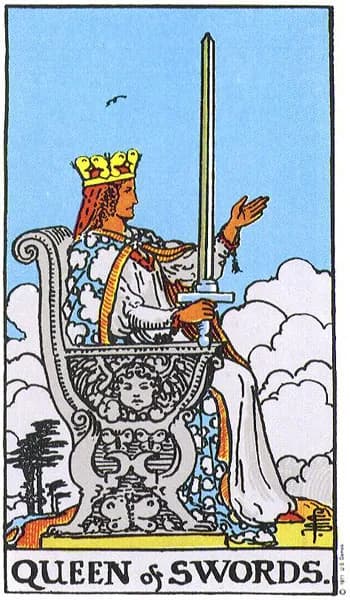
Queen of Swords
The Queen of Swords is also intellectual but leans toward sharp insight and independent inner judgment, while the King emphasizes public authority and responsibility for decisions.
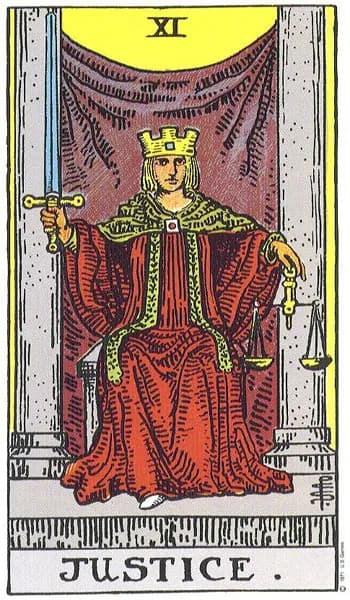
Justice
Justice symbolizes fairness and karmic balance, focused on principle itself; the King of Swords applies that principle to specific people and offices through rational ruling.
Read the card in your own context
A card’s general meaning is a starting point. Your question and its position in the spread help explain what it contributes to your reading.