
Page of Swords Tarot Card Meaning
The Page of Swords shows a young, sharp mental state: sword held upright, walking briskly, glancing around as if gathering news or watching for danger. Unlike the other Pages, its emphasis falls on observation, questioning and speech rather than feeling, action or material matters. The core tension is that vigilance can bring clarity and learning, while excessive vigilance turns into suspicion and gossip.
UPRIGHT
Quick, curious and watchful; suited to gathering information and asking questions, with a risk of haste or blunt speech.
REVERSED
Words misused, suspicion or prying, garbled news; also overthinking that delays speech or action.
Imagery & symbolism
The imagery described here follows the Rider–Waite–Smith deck.
- Sword held upright in both hands
- The figure grips the sword vertically before the body. This suggests the mind used as a tool held at the ready, useful for testing what is true, yet also a posture of defense.
- The stance on uneven ground
- The figure stands on uneven ground, with body and head turned in different directions. The posture suggests readiness to observe the surroundings, evoking alertness and a mind still considering possibilities rather than settled certainty.
- Wild clouds and backward glance
- Clouds churn overhead and the figure looks back. This suggests unsettled conditions and attention divided in several directions, alertness mixed with unease.
UPRIGHT
Upright, the Page of Swords often indicates a keen, curious, questioning frame of mind. Details others overlook become noticeable, making this a good time for study, research, gathering information, preliminary investigation or asking pointed questions. It brings quick perception and fast response, not mature judgment. The condition is that curiosity be directed toward honest learning and communication, with a willingness to verify what is found. The limit is equally clear: this energy is young and impatient, prone to concluding from fragments or offending others with direct speech. It marks the stage of seeing and asking, not of settling and executing.
REVERSED
Reversed, the Page of Swords can move in several directions. Vigilance may harden into suspicion, with motives read into everything and private prying; speech may misfire through saying too much too fast; information itself may be unreliable, so rumor passes as fact; or overthinking may stall both words and action. Reversal is not automatically negative, for it can also mean lowering one's guard, ceasing to over-monitor, or realizing that expression needs more care. The key is to distinguish whether the confusion comes from the surrounding information or from one's own tension.
Meanings by question
Love & relationships
UPRIGHT
In relationships this card often shows curiosity and testing the waters: wanting to know a partner, asking many questions, keeping some distance to observe. It suits honest exchange, but romance should not become an interrogation.
REVERSED
Reversed, suspicion, checking private messages, sharp words, or letting outsiders' gossip shake the bond may appear. It can also mean feelings that remain unspoken.
Career & work
UPRIGHT
At work it favors research, learning, intelligence gathering, drafting or raising new questions. It belongs to the information and communication stage rather than final decisions.
REVERSED
Reversed, it may point to office rumors, miscommunication, messages passed incorrectly, or rushing to perform before preparation is complete. It also warns against prying without doing the work.
Money & practical matters
UPRIGHT
Financially this card supports collecting data, comparing terms and asking about details, such as fee structures or contract conditions. It stresses understanding before deciding.
REVERSED
Reversed, watch for information from unclear sources, exaggerated recommendations, or unnecessary spending driven by impulse or a quarrel.
Common misconceptions
Does the Page of Swords represent a specific age or gender?
No. Page cards describe a mindset or role quality, such as curiosity, alertness or a habit of asking questions, not a fixed age, gender or identity. It may fit anyone, or simply the querent's present state.
Does reversal always mean someone is lying or betraying?
Not necessarily. Reversal can indicate muddled information, poor expression, excessive suspicion, or the release of defensiveness. Treating it as certain betrayal mistakes one possibility for a conclusion.
Related cards & differences
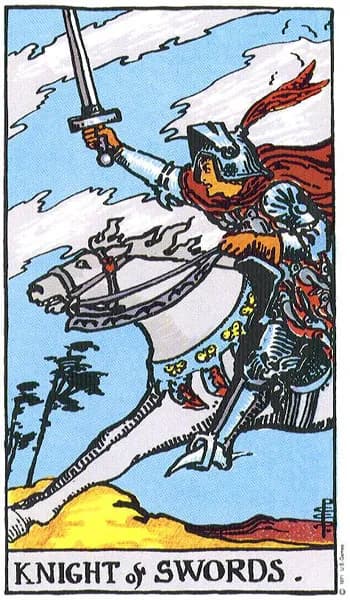
Knight of Swords
The Knight of Swords is also quick-minded but far more forceful and direct; the Page observes and asks, while the Knight has already charged into action.
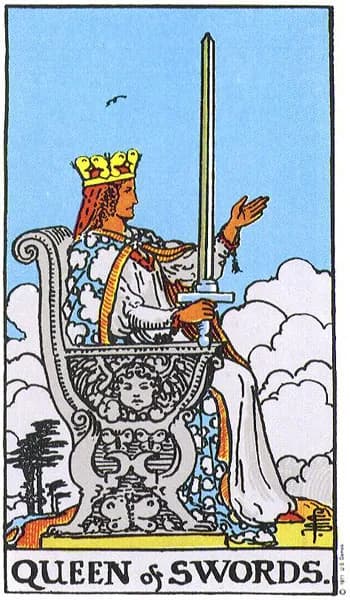
Queen of Swords
The Queen of Swords also values clarity and truth but is more mature and detached, judging independently; the Page is still learning to wield that sharpness.
Read the card in your own context
A card’s general meaning is a starting point. Your question and its position in the spread help explain what it contributes to your reading.