
Eight of Pentacles Tarot Card Meaning
The core tension of the Eight of Pentacles lies between focus and repetition. The artisan in the image carves one pentacle at a time, pouring attention into a concrete craft. Unlike other pentacle cards, it does not emphasize possession or exchange but the making itself. It suggests that results often come from repeated practice and patient refinement rather than sudden inspiration or luck.
UPRIGHT
The Eight of Pentacles points to focused craft and repeated practice, building skill through steady labor.
REVERSED
Reversed, it can show blocked skill, excessive repetition, or effort turning toward shortcuts and vanity.
Imagery & symbolism
The imagery described here follows the Rider–Waite–Smith deck.
- The artisan bent over his work
- The figure lowers his head toward the pentacle in his hands, suggesting that labor demands full attention and that the mind is fixed on the task at hand.
- Completed pentacles on display
- Finished pentacles are arranged along the wall or post as visible trophies, suggesting that steady accumulation leaves a record that can be seen.
- Hammer and chisel
- The artisan strikes the pentacle with tools, which evoke method rather than force and hint that progress comes through small, repeated corrections.
UPRIGHT
Upright, the Eight of Pentacles is associated with focused learning, repeated practice, and steady labor. It appears when someone is willing to settle down and refine a skill, accepting a slow process. This may be a patient job, a craft being improved, or professional ability built up over time. The opportunity is that sustained effort brings real proficiency and dependable results, and skill tends to be recognized by others. The limit is that such focus often costs speed and breadth; staring only at details can lose the larger direction. It does not promise immediate success but places weight on process and accumulation.
REVERSED
Reversed, the Eight of Pentacles has several possible readings. It may indicate stagnation or blockage in skill, such as poor practice methods, lack of feedback, or exhaustion from repetitive work. It can also point to over-investment, spending all energy on details and losing the whole picture, or turning diligence into mechanical repetition. Another reading is that effort shifts toward shortcuts, surface polish, or vain results rather than genuine ability. Reversal is not always negative; it may suggest stepping back from the work to reconsider direction or applying a skill somewhere more suitable.
Meanings by question
Love & relationships
UPRIGHT
In relationships, it can show both people willing to invest time and patience, slowly adjusting through daily contact and valuing practical effort over empty promises.
REVERSED
Reversed, it may show effort becoming mechanical or unbalanced, one person absorbed in tasks while neglecting emotional exchange, or energy spent on keeping up appearances.
Career & work
UPRIGHT
At work, it points to focused skill improvement and careful completion of tasks, suited to learning a new ability or refining professional details, with results coming from practice.
REVERSED
Reversed, it may indicate work stuck in repetition without growth, or attention given to shortcuts and presentation rather than real competence, possibly signaling a need to adjust direction or method.
Money & practical matters
UPRIGHT
In money matters, it leans toward income built through steady labor and skill, valuing practical management rather than speculation or quick gains.
REVERSED
Reversed, it may show neglect of practical matters through shortcuts or vanity spending, or income not matching effort, calling for a review of how money is used.
Common misconceptions
Does the Eight of Pentacles guarantee success or rich rewards?
It points more to the process of focus and practice than to a promised result. It describes the conditions of effort and refinement but does not guarantee the size or timing of returns, which still depend on direction and circumstance.
Does reversal mean laziness or total failure?
Reversal does not necessarily mean laziness. It may indicate poor methods, excessive repetition, or effort turning toward shortcuts, and it can also suggest a pause and adjustment rather than complete failure.
Related cards & differences
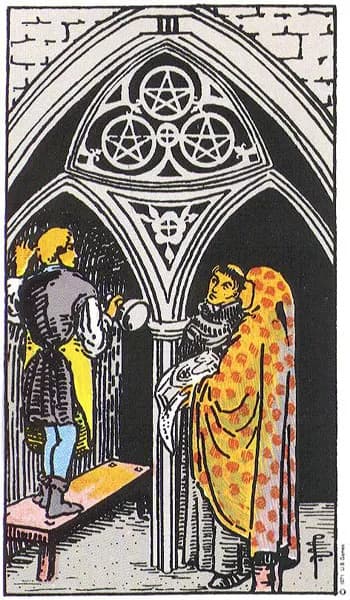
Three of Pentacles
The Three of Pentacles emphasizes collaboration and early recognition, while the Eight focuses on individual repeated practice and craft refinement; both concern work but stress different sides.
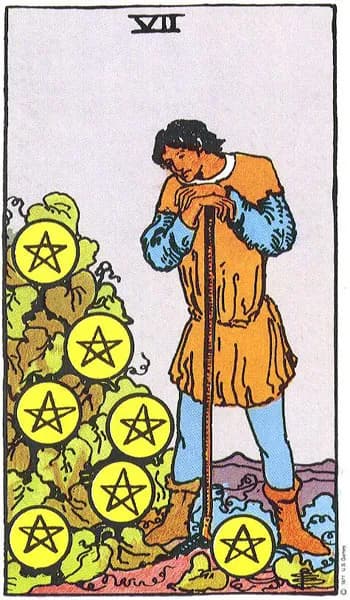
Seven of Pentacles
The Seven of Pentacles watches for harvest and evaluates investment, while the Eight is in the midst of ongoing labor, one looking back and the other working hands-on.
Read the card in your own context
A card’s general meaning is a starting point. Your question and its position in the spread help explain what it contributes to your reading.