The Hierophant Tarot Card Meaning
The Hierophant's core tension lies between external religious authority and inner spiritual experience. Seated between two pillars that are not those of the High Priestess's temple, wearing a triple crown and holding a triple-crossed sceptre, he symbolizes the institutionalized system of faith and the transmission of orthodox doctrine. Unlike the silent, withdrawn High Priestess, he actively makes the esoteric sign, distinguishing manifest from concealed doctrine, representing visible teaching, ritual, and hierarchy. He is not philosophy, inspiration, or religion itself, but a mode of its expression, emphasizing salvation and order through visible institutions and lineage.
UPRIGHT
Seeking guidance through established tradition and institutions, finding belonging and meaning via formal study, ritual, or a mentor.
REVERSED
Rebellion against rigid dogma, blind conformity, or a disconnect between inner belief and outer form; re-examining authority.
Imagery & symbolism
The imagery described here follows the Rider–Waite–Smith deck.
- Triple crown and triple-crossed sceptre
- Both crown and sceptre are triple in form, suggesting the Hierophant governs doctrine, ritual, and governance. The triple cross at the sceptre's end indicates authority derived from religious tradition rather than personal charisma, stressing institutional transmission.
- Two pillars not of the temple
- These pillars differ from those of the High Priestess's temple, marking the Hierophant's domain as external, public religious structure rather than an inner hidden sanctuary. They frame a public teaching space, implying authority requires visible structures.
- Crossed keys and kneeling acolytes
- The crossed keys symbolize the dual power to open and to bind, representing doctrine that both liberates and constrains. Two acolytes in albs kneel before him, embodying hierarchy and lineage, suggesting truth is mediated rather than directly accessed by all.
UPRIGHT
The upright Hierophant typically points to identification with and reliance on tradition, institutions, and formal teaching. It may indicate a phase suited to apprenticeship, joining a group, following established norms, or accepting authoritative guidance. This force brings belonging, order, and a followable path, offering a stable framework of meaning in complex situations. Its limitation is that when authority becomes absolute, direct personal experience may be suppressed, and dogma can replace living insight. The card encourages respect for lineage while discerning which teachings truly serve growth and which merely maintain institutional inertia.
REVERSED
Reversed, the Hierophant can take several forms: open rebellion against rigid dogma, or another kind of bondage through blind conformity; a disconnect between outer ritual and inner belief; or over-reliance on others' judgment at the cost of autonomy. It sometimes signals withdrawal from an institution in search of a more personal spiritual path, or legitimate questioning of a mentor or organization. But reversal does not mean wholesale rejection of tradition; it points more to imbalance—either rebelling so much that roots are lost, or conforming so much that the self is lost. The key is to examine whether your relationship with authority is authentic, free, and responsible.
Meanings by question
Love & relationships
UPRIGHT
In relationships, the Hierophant may point to valuing traditional commitment forms (such as marriage or family approval), or shared values and faith as a bond. It can also show the relationship deeply shaped by elders, culture, or religious norms.
REVERSED
Reversed, it may reflect resistance to traditional relationship models, or disagreements over faith and family expectations. It can also suggest a relationship held hostage by external norms, lacking genuine intimacy and autonomous choice.
Career & work
UPRIGHT
At work, this card often relates to formal education, certification, mentorship, or large institutions. It may indicate that following established procedures, accepting supervision, or entering a field with clear hierarchy and tradition brings stable development.
REVERSED
Reversed, it may point to dissatisfaction with rigid workplace rules, conflict with authority figures, or feeling trapped by institutional expectations. It can also indicate leaving a conventional career path for a more self-directed direction.
Money & practical matters
UPRIGHT
Financially, the Hierophant leans conservative, following conventional advice such as consulting professional advisors, using traditional savings or investment methods, and prioritizing long-term stability over short-term speculation.
REVERSED
Reversed, it may indicate skepticism toward traditional financial advice, or blindly following authority while ignoring one's own situation. It can also point to financial pressure from institutional factors such as policies or organizational rules.
Common misconceptions
Is the Hierophant the same as religious or spiritual authority itself?
No. Waite explicitly says he is not religion itself, but a mode of its expression, a symbol of the outer institutional level. He represents visible lineage, ritual, and hierarchy, not direct inner spiritual experience. Equating him with spirituality itself overlooks the hidden wisdom of the High Priestess.
Does reversal always mean rebellion or rejection of tradition?
Not necessarily. Reversal can mean rebellion, but also blind conformity, formalism, or a disconnect between inner and outer. It reveals more about an imbalance in your relationship with authority than simple opposition. Sometimes reversal invites you to reconnect with tradition in a more authentic, personal way.
Related cards & differences
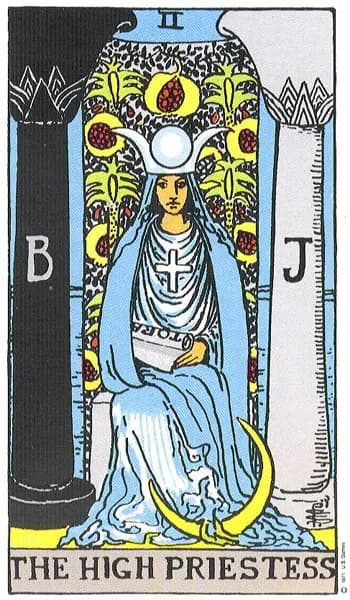
High Priestess
The High Priestess represents inner, silent hidden wisdom and makes no outer sign; the Hierophant represents outer, public institutional teaching and actively transmits doctrine. They form a complementary contrast of inner and outer.
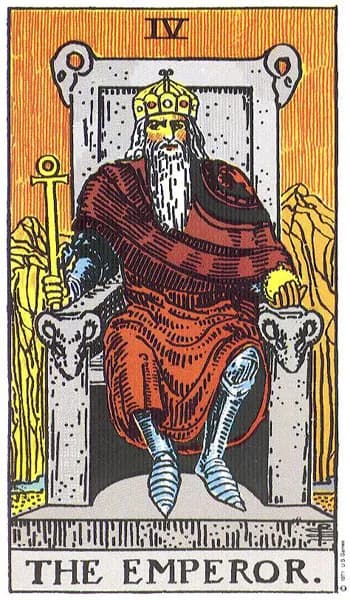
The Emperor
The Emperor symbolizes secular power, order, and law; the Hierophant symbolizes religious authority, doctrine, and ritual. Both concern authority, but in different domains: one governs the worldly, the other guides belief.
Read the card in your own context
A card’s general meaning is a starting point. Your question and its position in the spread help explain what it contributes to your reading.