Death Tarot Card Meaning
The core tension of Death is that ending and renewal occur together: it is not the cessation of life but a change of form. Unlike cards that emphasize gradual adjustment, it points to an unavoidable, structural conclusion in which an old identity, relationship or situation can no longer remain as it was. The skeletal rider carries no visible weapon, suggesting this transition is not violently imposed but part of a natural process. It differs from the sudden collapse of the Tower and from the summons and reckoning of Judgement; its emphasis is on release and passage itself.
UPRIGHT
An old form reaches its end, and transformation follows, clearing space for a new phase.
REVERSED
Resisting a necessary ending, or change stalled and delayed; also slow inner transformation.
Imagery & symbolism
The imagery described here follows the Rider–Waite–Smith deck.
- Skeletal rider on a white horse
- A skeleton rides slowly forward with no visible weapon in hand. This suggests that the ending is not an external punishment or attack but a stage that arrives naturally within the cycle of life, something no one can resist by force or bargain away.
- Black banner with the Mystic Rose
- The rider holds a black banner marked with a white rose. Black evokes mourning and the unknown, while the rose here signifies life itself; placed together, they suggest that beneath the appearance of dissolution, life continues and renews.
- King, child, maiden and prelate
- A fallen king, a kneeling child and woman, and a standing prelate meet the rider in different ways. Their contrasting positions suggest that status and experience do not hold a stage of life still, although responses to transition can differ.
UPRIGHT
Death upright tends to appear when a phase has genuinely run its course: a relationship, a job, a self-image or a way of living can no longer continue in its existing form. Its opportunity lies in thorough clearing rather than repair. When people acknowledge that something has ended, energy previously spent maintaining the status quo can be released toward a new direction. Its condition is the courage to face loss, including the loss of familiarity, security and an old identity. Its limit is that the pace is rarely fully under personal control; resistance may prolong pain but cannot stop the process. It does not promise that the next phase will be immediately clear, only that an old structure is dissolving, and the transition may bring confusion and grief.
REVERSED
Death reversed has several possible readings. One is resistance to an ending: knowing a relationship or situation cannot be salvaged, yet holding on through habit, duty or fear, leaving both parties stuck. Another is delayed or blocked transition, where external conditions or inner hesitation prevent completion, leaving a person in a middle state that is neither the old nor the new. It can also indicate change happening inwardly, with little visible on the surface while values and self-understanding slowly loosen. In some cases it points to over-attachment to loss, remaining in mourning so long that life cannot flow again. In each case, the key is recognizing what is being resisted, what that resistance protects, and what it costs.
Meanings by question
Love & relationships
UPRIGHT
A phase in the relationship has ended, whether an old pattern of interaction, a shared living arrangement, or each person's definition of the bond. It does not necessarily mean separation, but asks both to release an expired way of relating and renegotiate their positions.
REVERSED
One or both parties refuse to acknowledge that the relationship has changed, preserving surface stability to avoid a necessary conversation. It may also point to post-breakup entanglement, an old attachment that will not be released, or a relationship stalled without real movement.
Career & work
UPRIGHT
A job, a position or a professional identity reaches its end, whether through a deliberate departure or structural change. It suggests redirecting energy from salvaging the old situation toward preparing the next stage, including updating skills and mindset.
REVERSED
Knowing a current role offers no room to grow, yet delaying the decision out of comfort or inertia. It may also describe organizational changes that drag on unresolved, leaving people in prolonged uncertainty and waiting.
Money & practical matters
UPRIGHT
A source of income or a financial arrangement may be ending and needs replanning. It is better understood as a moment to restructure, such as reducing reliance on a single source, rather than as a prediction of specific gains or losses.
REVERSED
Financial change is postponed or avoided, for example refusing to face a budget method that no longer works, or clinging out of fear to arrangements that are clearly no longer suitable, allowing problems to accumulate.
Common misconceptions
Does drawing Death mean someone will die?
No. In tarot this card symbolizes transformation of form and the end of an old phase, not literal death. Mistaking a symbolic ending for a prediction about life creates unnecessary fear and obscures what it actually points to: release and transition.
Is Death the same as a Tower-like disaster?
Both involve upheaval, but of different kinds. The Tower emphasizes sudden collapse and being caught off guard, while Death is closer to a natural conclusion that arrives relatively slowly and can be prepared for. It asks for acceptance and letting go, not hurried scrambling amid ruins.
Related cards & differences
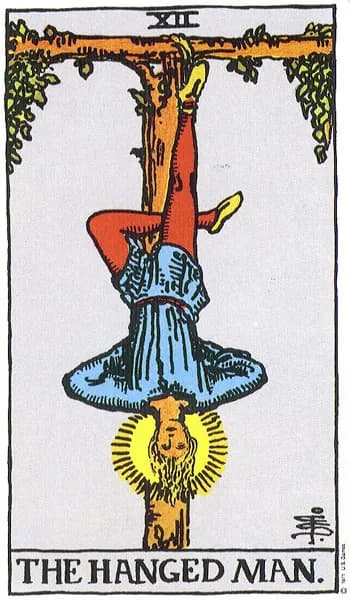
The Hanged Man
The Hanged Man describes a voluntary pause and shift of perspective while the situation itself has not ended; Death points to a phase truly concluding, with no return to the previous state.
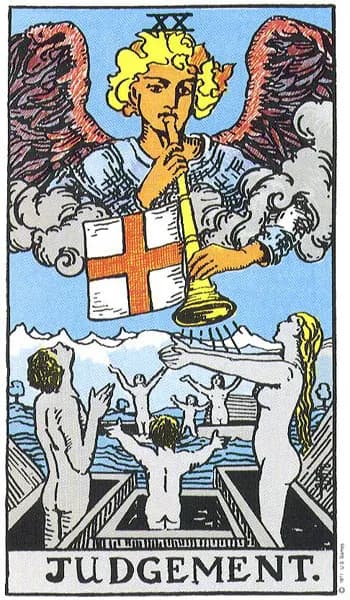
Judgement
Judgement emphasizes review, reckoning and an awakening call, carrying a sense of reassessment; Death focuses on release and passage itself, without passing verdict on the past.
Read the card in your own context
A card’s general meaning is a starting point. Your question and its position in the spread help explain what it contributes to your reading.