
Justice Tarot Card Meaning
Justice centers on the tension between an outer principle of fairness and an inner sense of moral responsibility. Unlike the High Priestess, who suggests hidden spiritual knowledge, Justice emphasizes measurable cause and effect: every choice carries a consequence. The seated figure between two pillars holds a balance and an upright sword, neither punishing nor rewarding, but requiring clear sight and accountability. The card asks for honest assessment rather than emotional retaliation or unconditional leniency. It is less about winning and more about whether the process itself is truthful and consistent.
UPRIGHT
Weigh a situation with honesty, evidence and responsibility, then make a decision you can own.
REVERSED
Bias, avoidance or harsh over-judgment may distort the scales; recalibrate your standards.
Imagery & symbolism
The imagery described here follows the Rider–Waite–Smith deck.
- Figure seated between two pillars
- The figure sits upright and still between two pillars, suggesting impartiality that rises above opposing sides. The pillars also evoke order and boundary, implying that judgment must rest on clear rules and facts rather than personal preference.
- Balance held in the left hand
- The scales appear in a state of weighing, symbolizing the cool comparison of evidence, actions and consequences. It suggests gathering facts and measuring their weight before deciding, rather than rushing to a conclusion from bias or impulse.
- Upright sword in the right hand
- The sword points straight upward, representing reason, clarity and the power to enact a verdict. It implies that justice requires not only judgment but also the courage to carry it out, with words and actions that are direct and responsible.
UPRIGHT
Upright Justice often marks a phase that calls for honesty and rational assessment. You may be dealing with contracts, disputes, accountability or a significant choice. Favorable conditions include relatively clear facts, usable rules and your own willingness to own the outcome. The card encourages collecting evidence, hearing more than one side, and making an even-handed decision. Its limit is that fairness does not mean pleasing everyone; sometimes you must acknowledge a past mistake and accept the result. It does not promise a favorable verdict, but stresses whether the process is truthful and the standard consistent. When you accept the consequences of your choices, Justice can bring a clarifying stability that returns relationships, work or finances to a predictable track.
REVERSED
Reversed Justice can point to several possibilities. One is a distorted standard: bias, double standards, incomplete information or emotional interference throws the scales off. Another is avoidance of responsibility, where a known fault is deflected, delayed or circumvented. It can also swing the other way into harshness, applying an inhumane judgment to yourself or others. Reversal is not automatically a bad outcome; it is more a prompt to re-examine what standard you are using, whether some facts are ignored, and whether fairness has turned into punishment. In legal or contractual matters it suggests checking details more carefully rather than declaring certain defeat. On a personal level, it may show that you have not yet forgiven yourself or truly faced the consequences of a choice.
Meanings by question
Love & relationships
UPRIGHT
In relationships, Justice stresses equality and honesty. Both people need to speak plainly about expectations and responsibilities rather than relying on guesswork. It suits discussions of commitment, shared duties or rebuilding trust, provided both are willing to face facts.
REVERSED
Reversed, a relationship may be out of balance: one person carries too much, standards differ, or silence and blame replace communication. It asks you to check for double standards, not to conclude that infidelity or a breakup is certain.
Career & work
UPRIGHT
At work, Justice often relates to fair evaluation, contracts, reviews or personnel decisions. It encourages speaking with professionalism and evidence, following procedure, and taking responsibility for what you deliver. A fair environment supports steady progress.
REVERSED
Reversed may indicate favoritism, opaque processes or deflected responsibility at work. It suggests keeping records, clarifying duties and examining whether you too are substituting emotion for standards, rather than predicting a lost job or certain dispute.
Money & practical matters
UPRIGHT
Financially, Justice supports a rational, transparent approach: checking accounts, honoring agreements and keeping income and spending in line. It suits budgeting, tax or debt organization, emphasizing living within means and meeting prior commitments.
REVERSED
Reversed, accounts may be unclear, debts avoided or gains and losses over-analyzed. It asks you to recheck numbers and terms and to avoid decisions based on wishful thinking or emotion, without giving specific investment instructions.
Common misconceptions
Does Justice guarantee a verdict in my favor?
No. Justice emphasizes consistency, honesty and accountability rather than a result tilted toward one side. It may ask you to accept a fact-based conclusion even when it does not match your hopes.
Does reversal mean certain failure or injustice?
Not necessarily. Reversal more often signals a problem in the weighing process: blurred standards, avoided responsibility or excessive harshness. It invites recalibration, not a verdict on the outcome.
Related cards & differences
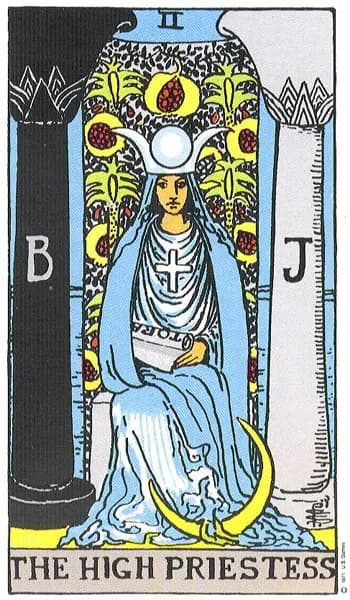
High Priestess
The High Priestess also sits between two pillars, but hers open onto inner intuition and hidden knowledge, while Justice's pillars open onto measurable moral order and outer judgment.
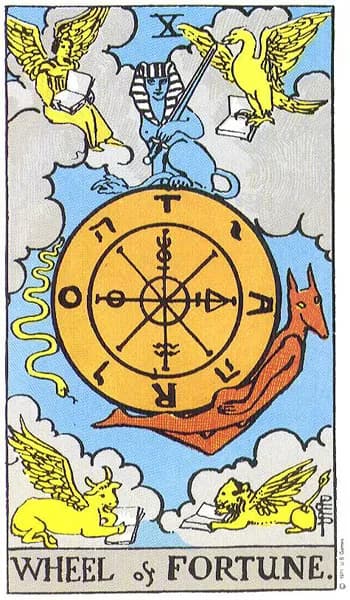
Wheel of Fortune
Wheel of Fortune stresses cycles and chance turns, whereas Justice stresses deliberate weighing, responsibility and cause and effect, one leaning toward flux and the other toward judgment.
Read the card in your own context
A card’s general meaning is a starting point. Your question and its position in the spread help explain what it contributes to your reading.